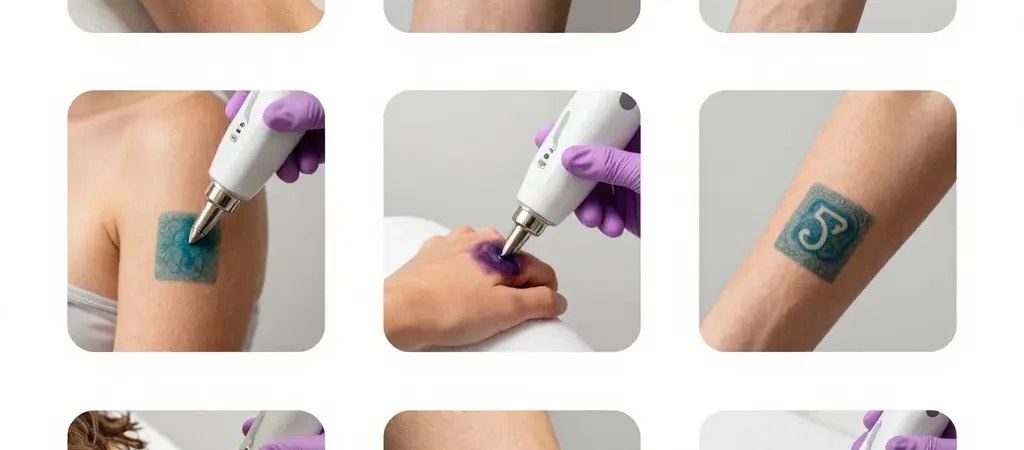
Introduction
There is no single answer to how long tattoo removal takes. Two things shape the timeline more than the laser settings: ink color and how far apart sessions are scheduled. A favorable tattoo can finish in about 5 visits; a stubborn one may need 15 or more.
This guide is for three groups: people deciding whether to start removal, clinics planning schedules they can actually keep, and cosmetic dermatology practitioners who set expectations with patients. The tone is informative, not promotional, so you can lift it into a consultation or use it for your own research.
Five parts explain the range. Ink chemistry comes first, and why some pigments clear quickly while others resist. Then spacing intervals and the biology behind the minimum gap between sessions, followed by a direct comparison of visit counts. The last two parts lay out a timeline you can map onto a real treatment plan, then a short FAQ. If you want the broad picture first, see the fundamentals of overall removal duration.
Why Ink Color Sets the Pace of Tattoo Removal
A laser doesn’t “know” what color your ink is. It only responds to how much energy the pigment absorbs. That one physical fact explains why ink color affects removal so much, and why two same-sized tattoos can mean 5 visits or 15.
Laser wavelength is the color of light a device emits. Each wavelength is absorbed by some pigments and reflected by others. The more efficiently a pigment absorbs the light, the faster it breaks into fragments your immune system can carry off.
Black and dark blue are the easiest. They absorb the common Nd:YAG (1064 nm) wavelength well, break down quickly, and typically clear in the fewest sessions.
Red and orange respond to the green 532 nm wavelength, which most clinics already have on hand. They still take more passes than black, but the platform is widely available.
Green, light blue, and yellow are harder. They reflect much of the standard laser energy, clear slowly, and often need extra passes. Clinics usually switch platforms — to a 755 nm alexandrite or 694 nm ruby laser — to reach them.
White and very light skin pigments carry a specific risk. Certain wavelengths can darken them instead of fading them, because the laser oxidizes the pigment rather than breaking it apart.
That absorption gap is why any honest estimate of how many sessions for tattoo removal you will need starts with your ink’s palette, not just the size of the piece. To see how session counts stack up across different tattoos, compare real-world examples before you book your first appointment.
The table below is a quick reference. Colors closest to a laser’s peak absorption clear fastest, which is the point to make when you set expectations with clients.
| Ink Color | Laser Absorption | Removal Difficulty | Estimated Sessions (range) |
|---|---|---|---|
| Black | Highest (broad, multi-wavelength) | Easiest | 4-6 |
| Dark Blue | High | Easy to moderate | 5-8 |
| Green | Low (narrow absorption band) | Moderate to hard | 8-12 |
| Red | Low (wavelength-specific) | Hard | 8-14 |
| Orange/Yellow | Very low | Hard | 10-15 |
| Light Blue/Teal | Very low | Very hard | 10-16 |
| White/Ivory | Poor (may oxidize and darken) | Very hard | 12-16+ |
| Cosmetic/Skin-toned | Variable, frequently poor | Very hard | 10-16+ |
Once you know your ink palette, the other big lever is timing. Spacing sessions correctly is what separates a lean 5-visit plan from a drawn-out 15-visit slog, so it helps to understand how many sessions laser tattoo removal typically demands before booking the first appointment.
Why Session Spacing Dictates Your Total Visit Count
The gap between appointments matters as much as the laser. Spacing is not a scheduling convenience; it is a biological requirement. After each treatment, the laser breaks the ink into tiny fragments, but your body does the clearing. Immune cells called macrophages carry that debris away through the lymphatic system, and the process takes weeks, not hours.
The biology behind the 6-to-8-week window
Most clinics recommend a laser session interval of roughly six to eight weeks for a reason. In the days right after a session, the treated area is still inflamed and full of pigment debris. It usually takes four to six weeks before the immune system has cleared enough fragmented ink to make another pass worthwhile. For certain skin types, larger tattoos, or areas with slower circulation, that window stretches longer. Waiting allows fuller clearance and lowers the risk of scarring or hypopigmentation, where the skin loses its natural color.
Why compressing sessions backfires
Booking treatments closer together does not speed things up. Treating skin before it has recovered hits the same pigment with no fresh clearance to show for it, adding cost, discomfort, and risk without accelerating the result. Spacing sessions too widely has the opposite problem: it stretches your calendar for no clinical benefit. As the guide to how long does tattoo removal take explains, total visit count is driven by how completely each session clears ink, not by how often you sit in the chair.
Planning your real timeline
If you want fewer visits, respect the recovery clock. A well-timed schedule lets each session build on the last, so total appointments stay predictable. Rush the intervals, and you pay more for slower progress.
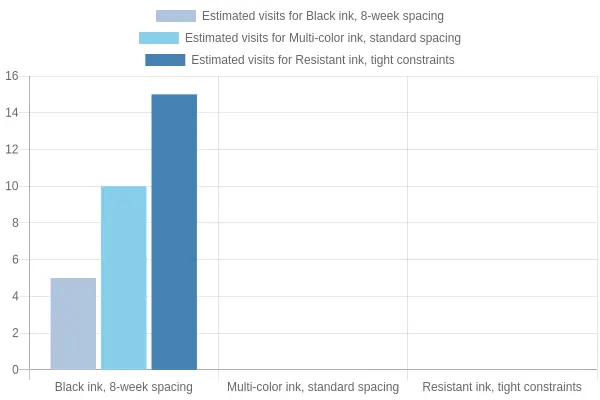
Estimated visits: favorable vs difficult removal – Favorable cases such as black ink spaced eight weeks apart may clear in about 5 visits, while multi-color or resistant ink with tight constraints can stretch the total to roughly 15.
The 5-Visit Scenario: When Conditions Line Up
A fast tattoo removal timeline is not luck. It is several favorable factors stacking together. When most of them align, a tattoo can clear in roughly 5 visits.
The Contributing Factors
- Small size: less total pigment to clear.
- Single-color black or dark blue ink: absorbs laser energy across the widest wavelength range.
- Good contrast against skin tone: more energy reaches the ink, less reaches the skin.
- Healthy skin: repairs faster, so fewer rest periods are needed.
- 6-to-8-week spacing: lets the body flush out broken-down ink.
- Competent practitioner: chooses settings that clear pigment without scarring.
Why These Converge on Fewer Sessions
Dark, single-color ink responds to the broadest set of wavelengths, and small areas hold less total pigment. Strong contrast and healthy skin both raise how much pigment each pulse removes. Together, those factors reduce the number of passes.
Each visit builds on the pigment cleared after the previous one. Early sessions shatter surface pigment. Later sessions reach deeper deposits. Because the body keeps clearing ink during the 6-to-8-week intervals, the results compound. That is why the same tattoo can need anywhere from 5 to 15 sessions — see how many sessions laser tattoo removal requires — based only on these conditions.
| Factor | Effect on Session Count |
|---|---|
| Small size | Fewer sessions |
| Single-color black or dark blue ink | Fewer sessions |
| Good contrast with skin tone | Fewer sessions |
| Healthy skin | Fewer sessions |
| Consistent 6-to-8-week spacing | Fewer sessions |
| Competent practitioner | Fewer sessions |
The chart below shows how session counts scale with tattoo profile, comparing the 5-session best case against larger, multi-color tattoos.
When Treatment Stretches Toward 15 Visits
A tattoo that needs five sessions and one that needs fifteen can look almost identical on the day they are finished. The difference emerges later, in how the ink, the skin, and the schedule interact. When several difficult factors stack on a single piece, a realistic plan shifts toward 15 visits, and treatment can run past two years.
The Factors That Add Sessions
| Contributing factor | How it raises the session count |
|---|---|
| Large coverage | More surface area means more ink to break down and more passes per area. |
| Layered or multi-color ink | Green, yellow, white, and cosmetic pigments absorb laser energy poorly or unevenly, so they clear slowly. |
| Heavy saturation | Densely packed ink holds more pigment than the immune system can clear between sessions. |
| Scarred or previously treated skin | Scar tissue clears ink more slowly and often calls for gentler, less aggressive settings. |
| Long or inconsistent spacing | Gaps stretch the calendar even when each individual response is good. |
Why These Factors Compound
Large coverage rarely arrives alone. A big piece tends to be heavily saturated, and it often carries multiple colors, including difficult pigments such as green, yellow, or cosmetic inks. Each factor raises the count on its own; together they multiply the workload.
The Calendar Effect
Session count and spacing move together. When tissue clears slowly, waiting longer between visits is safer, but those longer gaps push the finish line further out. A client may respond well at every session and still need more than a year of treatment because the piece is dense and multicolored. Clinics that plan realistically, rather than promising a fixed number, tend to keep expectations aligned with outcomes.
To gauge how many appointments a specific tattoo may need, review how many sessions tattoo removal typically requires before committing to a plan.
Why does one tattoo clear in five visits while another drags past fifteen? The answer usually hides in a handful of variables. The number of sessions is never an exact science, but these factors consistently push total treatment time toward the slower end:
- Ink color resistance – Vibrant greens, yellows, and light blues sit stubbornly at the far end of the laser absorption spectrum and clear far more slowly than black or dark blue.
- Tattoo age – Older, well-settled ink has already begun breaking down and often responds faster, while fresh, densely packed work keeps fighting back.
- Ink layering and saturation – Cover-ups, multiple passes, and heavily saturated fills force every session to chip away at deeper, denser pigment.
- Tattoo size and location – Large pieces, plus areas with slower blood flow such as ankles, fingers, and feet, simply demand more appointments.
- Skin tone and Fitzpatrick type – Higher Fitzpatrick types need gentler laser settings to protect surrounding melanin, which stretches the schedule to avoid burns or pigmentation changes.
- Session spacing discipline – Returning before your immune system has cleared the previous round slows clearance and raises the risk of scarring.
- Aftercare adherence – Skipping aftercare instructions invites infection, blistering, or delayed healing that pushes your next appointment back.
- Individual immune response – Age, health, hydration, and metabolism all influence how quickly your body transports away the shattered ink particles.
So if you want the shortest realistic timeline, guard the gap between sessions instead of chasing speed. Disciplined spacing does more for your final result than any single aggressive session. To set expectations before you begin, know how many sessions laser tattoo removal typically takes.
The Total Timeline: Turning Session Counts into Calendar Months
When people ask how long tattoo removal takes, the honest answer is rarely a single number. It is two variables multiplied against each other: the number of visits and the gap between them. Multiply those, and you get the calendar time a person actually lives through — not just clinical sessions, but months of waiting.
At the commonly recommended 8-week spacing, the math is easy to frame:
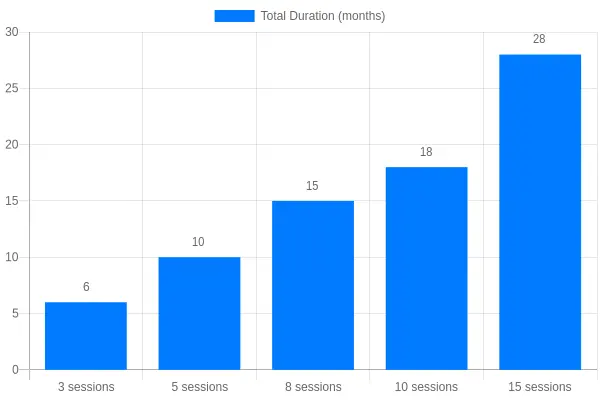
- 5 visits x 8 weeks = about 40 weeks, or roughly 10 months from first zap to last.
- 10 visits at the same spacing = about 80 weeks, or around 18 months.
- 15 visits = about 120 weeks, pushing the total tattoo removal duration toward 2.5 years.
So a smaller, forgiving tattoo that clears in five sessions wraps up inside a single year. A stubborn multicolor piece needing fifteen sessions can stretch across two and a half years of appointments, healing windows, and waiting.
How Interval Length Shifts Everything
Spacing is every bit as powerful as the session count. Compress treatments to 6-week intervals and that 15-visit plan shrinks to about 90 weeks, near 21 months. Stretch them to 12 weeks for cautious skin or dense ink, and the same 15-visit plan balloons past three years. Five visits at 12-week spacing alone can run about 14 months — longer than three visits at 8 weeks combined.
Your tattoo removal timeline is a multiplication problem, not a fixed promise. Count the sessions, confirm the interval your provider recommends, then multiply. That product — not the brand of laser or the price per session — decides how long you will spend watching ink fade. To see how each healing window feeds into the grand total, revisit our guide on how long tattoo removal really takes.
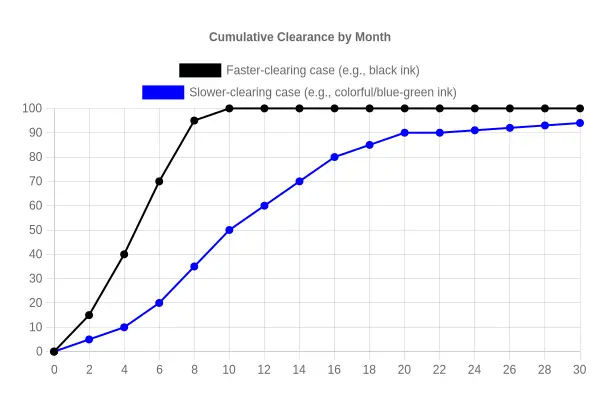
The faster-clearing case (such as black ink) climbs steeply to near-100% clearance within about 10 months, while the slower-clearing case (such as blue-green or multi-color ink) tags along gradually, only approaching full clearance somewhere between months 24 and 30.
For a deeper look at why session spacing and ink color reshape these timelines, see our guide on how many sessions laser tattoo removal really needs.
FAQ: Tattoo Removal Sessions and Spacing
This quick tattoo removal sessions FAQ covers the queries patients and clinics ask most, drawn straight from the ink-color and spacing logic above.
Does ink color really change how many sessions I need?
Yes. Black ink absorbs a wide range of laser wavelengths, so it often clears in the fewest passes, while green, yellow, and light-blue pigments reflect much of that energy and demand more visits. Because most lasers target one ink at a time, a multi-colored piece is typically handled in staggered stages rather than all at once. For the deeper breakdown, this guide on how many sessions laser tattoo removal really takes walks through the variables.
How far apart should laser sessions be?
Most providers advise spacing treatments four to eight weeks apart, stretching to twelve for dense or stubborn pieces. That gap is not clinic downtime — it is the window your immune system needs to carry away the fragmented ink particles already loosened by the last session.
Can sessions be spaced closer together to finish faster?
Rushing the schedule usually backfires. Treating skin before the previous session’s ink has cleared risks scarring, hypopigmentation, and texture changes that ultimately make finishing harder, not faster, so a two-week squeeze rarely shortens the total timeline.
Why does a green or yellow tattoo take longer than black?
Black absorbs across the near-infrared, including the common 1064 nm Nd:YAG setting. Green reflects green light, so it needs a longer wavelength — typically a 694 nm ruby or 755 nm alexandrite laser — and yellow absorbs poorly at most available settings. The result is more sessions at gentler intensities to protect the surrounding skin.
Do more visits always mean more cost?
Not necessarily. Per-session pricing often drops as treatments get smaller, and some clinics offer packages that spread the total across the whole course. Comparing the full projected cost — not the single-session rate — tells the truer financial story.
Is there a way to estimate how many visits to remove a tattoo before I start?
Yes. A practitioner can assess your tattoo’s ink colors, saturation, age, and placement, then give a realistic range — think five to six visits for simple black script versus twelve to fifteen for dense multi-color work. Getting that estimate in writing up front helps you plan both your budget and your calendar.